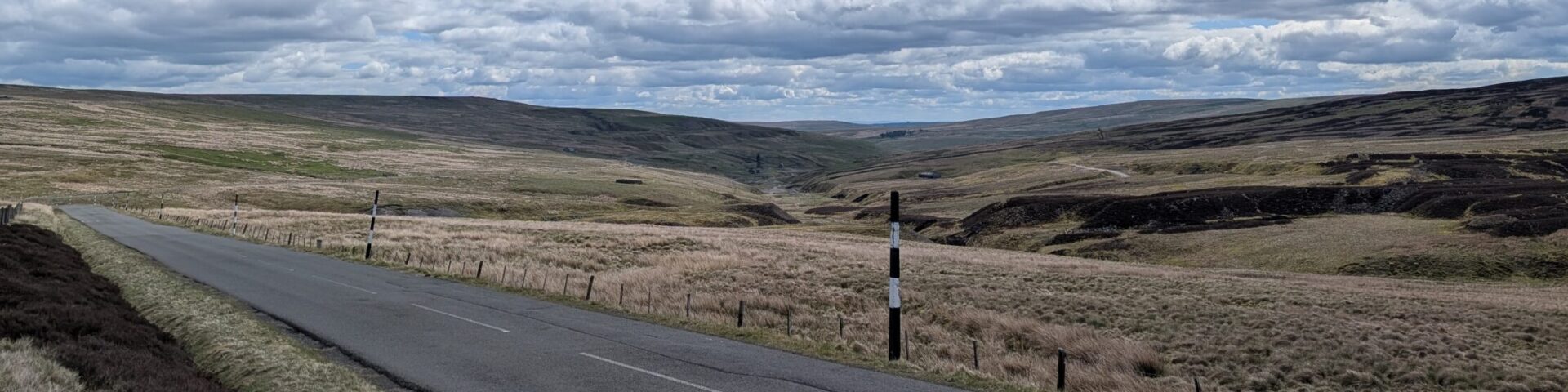
Richard Walsh sent us his reflection on the first “Church in the Wild”
Church in the Wild – a personal reflection
I’m sure you’ve all seen the film “Chariots of Fire.” There’s many iconic scenes, but one that always sticks in my mind is where the runner, Eric Liddell, having been berated by his sister (his training schedule meant he missed a church service), they go for an evening walk on Arthur’s Seat and Eric says “Jenny, you’ve got to understand, I believe that God made me for a purpose, for [missionary work in] China, but he also made me fast, and when I run I feel His pleasure, and to give it up would be to hold him in contempt. You were right. Its not just fun: to win is to honour Him.”
That’s something I understand completely. I’m no runner, and certainly no Olympian, but I enjoy fell walking and rockclimbing, and when I fully use this agèd body of mine, I feel that I am honouring the gift of physical ability that God has given me, and I too feel God’s pleasure.
So I was quite excited when our new vicar, the Reverend Graeme Holdsworth, started to talk about exploring the physical aspects of worship, pointing out Jesus taught that the greatest commandment is to “Love the Lord your God with all your heart, with all your soul and with all your strength.” Graeme – a very keen cyclist – was interested in exploring how we might use our beautiful Weardale countryside to worship God with the physical strengths he’s given us. His initiative, Church in the Wild, seeks to explore this idea (and the hyperlink takes you to Graeme’s vision for the initiative).
What did I think of Graeme’s idea
To be clear, this article sets out my perspectives on the initiative, not Graeme’s. We’ve had one “Church in the Wild” (on May the 16th): I’ll write a bit about my thoughts around the idea, and I’ll do a report on the event one that we’ve done. Then – because I think the idea has great potential – I’ll encourage you all to the next one, on the 6th June.
I particularly liked the idea of the Church being in the Wild (rather than, for example, expressing our physical worship through dance – I have two left feet, so that would never do!). I know there’s many folk apart from me who find their spirituality – and not just Christian spirituality – in the wild places, and part of Graeme’s vision is, I think, to engage with those people and to assist them by offering a loose framework. My own closest experiences of the spiritual (with a couple of exceptions) have been in the mountains, and not in church. Perhaps you will humour me if I share two of them?
A couple of examples from my life
The first was when I was young and daft (or at least, younger than I am now): probably eighteen. We went up Helvellyn, via the Striding and Swirral edges, ill equipped (one pair of crampons between us, and we lost half of that) in full on winter conditions. Crossing the summit plateaux between the two edges was the first time I’ve had to crawl across a mountaintop on my hands and knees because of the wind. But my overriding feeling I was enjoying some rough-and-tumble wrestling with my dad (as I used to when I was a child). I still love a good storm, and feeling the visceral strength and power in creation.
The second is more recent: I’d camped by Loch an Eoin at the foot of Maol Chean Dearg in Northwest Scotland: a cold night, with a skim of frost on the lochan as I woke. But the sense of peace and belonging as I emerged from my tent to the sunrise gilding the mountains opposite…is impossible to communicate…but I’m sure there’s folk reading this and nodding their heads in agreement…
What could possibly go wrong?
I saw a few problems with Graeme’s idea: for starters, not all of us are equipped with great physical strength (as above, I’m a very long way from being an Olympian – I wonder if Eric Liddell would have seen losing a race as honouring to God?). I don’t think the extent of our physical strength matters so much in this context; the important thing is to use it all in the worship of God. The story from the bible of “the widow’s mite” – where Jesus says that the widow giving all of the small amount she has is of more value than the rich man just giving a small fraction of his possessions – might be a helpful way of looking at things.
And another thing: when I read “with all your heart, soul and strength” I interpret that as “with every part of yourself, all at once.” Are we supposed to switch off our minds when we worship God with our strength? I hope not! My approach to most things is very cerebral and analytical. I’m not sure that’s something I can switch off.
And talking of switching, an obvious problem is that one cannot “switch on” the spiritual connection (or at least, I can’t). It comes in a flash, often unexpectedly when the clouds part on a mountainside, or a dipper suddenly pops out of the river. So how does it work to try and programme a spiritual experience for 12:30 on the first Saturday of the month?
With the last point in mind, I confess to being a tad uneasy with Graeme’s fairly liturgical approach. His plan is to provide us with a written prayer to read, and a passage from the bible, and that we were then to journey towards a prescribed meeting place, and as journeyed to allow the reading or the prayer to speak to us through our physical exertions.
The Great Experiment
And so the sun dawned on the morning of May 16th, the day of The Great Experiment. I read the prayer (asking that we might see more and more of the light of God as we meditate on His words), and the gospel reading (Luke 7:18-35 – the bit where John the Baptist sends messengers to ask if Jesus is the Christ, and Jesus offers a commentary on John’s ministry), packed some stuff into a backpack and set off, by myself, on the 8km or so over the fell to the prescribed meeting place.
I enjoyed the walk. No great surprise there. I enjoy walking. I enjoyed the solitude, the song of the lapwing and curlew, the silences in between and the rough grasses and mosses, punctuated by cloudberry blossom and bog asphodel. I struggled to focus on the reading – although I did sort out the meaning, at least to my own satisfaction, of one of the more opaque passages. There’s a bit where Jesus talks about reeds, and I observed (by experiment) that reeds are associated with water, and wondered if there was some spiritual metaphor kicking around there. It’s not unusual for me to have a hymn mulling around in my mind when I walk: whatever their faults, Wesleyan hymns move along at a good walking pace: on this morning “How Great Thou Art” seemed to fit.
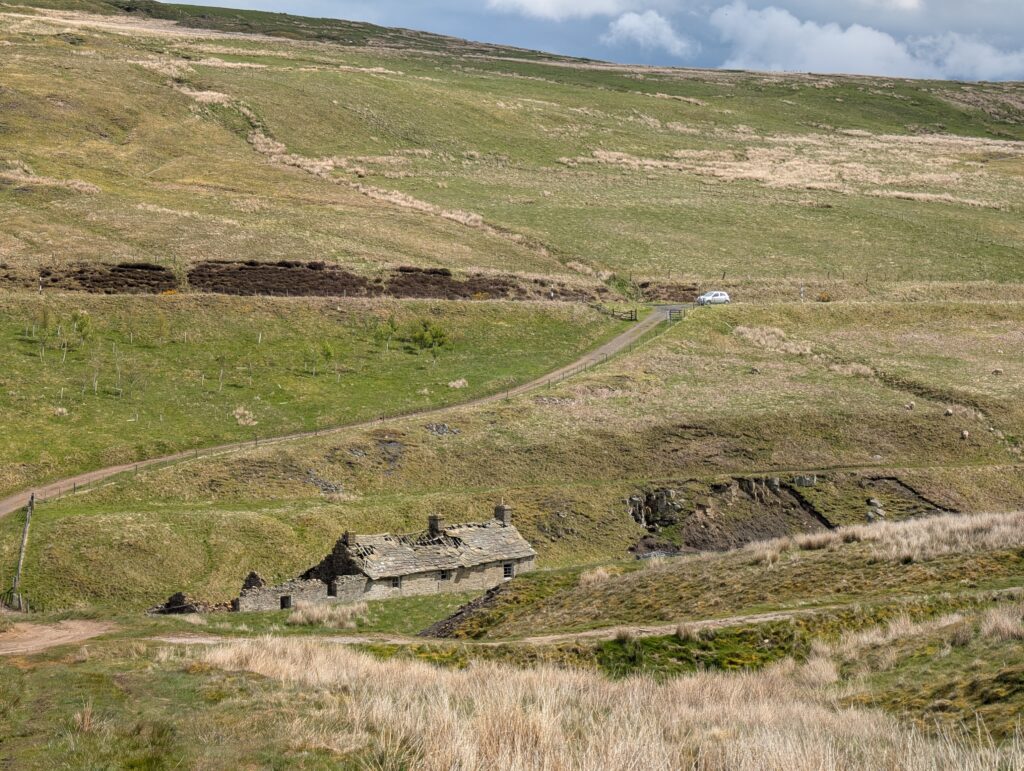
I arrived frightfully early to the prescribed meeting place, and amused myself cooking some Welsh Cakes in a patch of sunlight behind the ruined terrace of houses. Eventually Graeme arrived, on his bike, we said hello and as per The Instructions, we remembered to greet one another with a hearty “the Lord be with you.” Graeme brewed some coffee and shared the way the gospel reading had reflected in his thoughts as he cycled along.
We waited.
Another couple turned up. They had been waiting by the road, not realising that Graeme and I were hidden behind the buildings. We each shared our reflections, then shared cake. We were expecting a fifth person: whether she was unable to attend, or unable to find us I don’t know.
I don’t feel right about trying to put into my words the things Graeme and the other couple shared, but the thing that struck me as I walked was that, according to the Bible, John the Baptist recognised Jesus as the Christ when they were both still in the womb. So why is he questioning it now? What’s happened to that simple (pre)childlike faith? And as I often do, I turned to the reported word of Jesus “consider the pewit: she does not sow and she does not reap. Yet God from His bounty provides for her. And consider the cloudberry blossom: she does not weave, and she does not spin. Yet I tell you that not even Solomon in all his splendour was arrayed as the least of these” (you’ll see I use a slightly unorthodox translation of the bible).
So was the Great Experiment a success? I’d say that it was. I suspect that the format will settle down slightly, or perhaps even evolve over the summer, both in terms of how Graeme suggests we celebrate “Church in the Wild” and how we each choose to interpret Graeme’s suggestions. But I expect the concept to blossom, and to become an important part of the spirituality of the dale.
And the invitation
I’d certainly like to attend the next one, on the 6th June: I’d quite like to journey to the meeting place in company so that I have the opportunity to discuss the bible reading as I travel (get in touch if you want to join me), or look at different ways of getting to the meeting place (I think canoe would be cool, but Graeme would have to pick somewhere near to water, and I’d need to borrow a canoe and refresh my 30 year old skills).
Part of Graeme’s vision for Church in the Wild is, I think, to speak to those people who find spirituality in nature, or in physical activity, but feel uncomfortable in a traditional church setting. If there’s anyone reading this who is thinking “yes, that’s me,” then I’d encourage you to get in touch with Graeme, and to join the next event (or the one after, or the one after that…).